
Do you realize that the aircraft skin thickness is just about 63 thousandth of an inch (0.063 inch)? Well, it’s that kind of thickness that separates us in the comfort of the cabin from the ambient air outside while in flight.
Basically aircraft fuselages (from the
French fuselé "spindle-shaped") are of a tubular shape hence to give less resistance from the airflow and known as a
monocoque or a semi-
monocoque fuselage (stressed skin).
Monocoque is a French word meaning a “single shell” just like the shell of an egg. A true
monocoque fuselage has no internal structure members except for the
tranverse rings and
Bulkheads which serve to give contour to the outer skin or shell. All loads are impose on the skin only and a typical example of this can be found on the shell of the F1 cars.
Nowadays modern aircraft fuselages are of a semi-
monocoque (stressed skin) where the loads imposed are evenly distributed to the skin and the adjacent structures such as
longerons,
stringers and
frames. These give a much stronger fuselage if it is to compare to the olden age aircraft which traveled on a lot less speed than the modern aircraft.
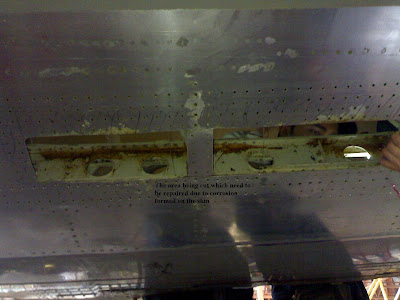
The image above shows how the skin on the belly just below the aft cargo being cut due to corrosion formed on the inner skin affected by moisture from the
cargos or leakage from the galley/lavatory in the cabin. The repair done is to remove the effected area and put a 2 pieces 0.050 and 0.063 inch
doublers of a
2024T3 aluminum clad material. Upon look closely, you could find how thin the skin is.
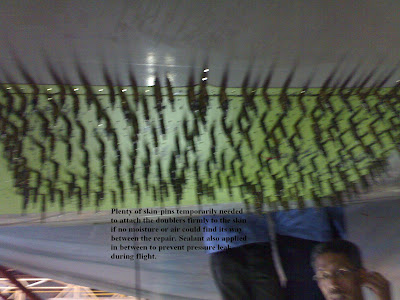
The second image shows how the
doublers looked after fabrication and coated with an anti-corrosive primer while being temporarily installed by using skin-pins according to the size of the fastener holes.
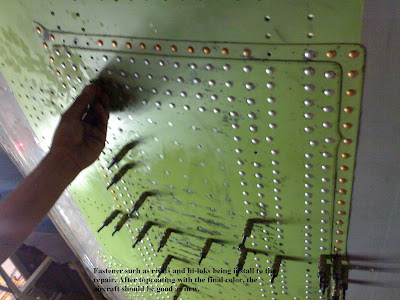
The last image shows that the job is halfway done where the
fasteners such as
rivets and hi-
loks being installed permanently on the repair and after the whole process was done, the painter will apply the normal white topcoat use by MAS
aircrafts.
So, how was that?


